Discovery Review With Multicam Sync and Timeline View
May 2026
·
3 min read
Modern discovery rarely tells a clear story on its own. It comes as dozens of disconnected files, inconsistent timestamps, and fragmented perspectives across volumes of recordings.
In 2026, even routine cases can have hours of audiovisual files across bodycams, dashcams, surveillance systems, interviews, and more. A single incident may involve footage from six officers, multiple camera angles, and overlapping recordings that each tell a slightly different part of the same story.
Defense attorneys often receive discovery close to trial and must review it under intense time pressure. Their main challenge is reconstructing the details of what actually happened.
Organizing multiple recordings of the same incident with a timeline view and multicam sync makes it faster to understand what happened and how the evidence fits together.
The problem with reviewing one recording at a time
Most video review workflows may still force defenders to approach evidence file by file.
Open one bodycam footage. Watch. Take notes. Open another angle. Rewatch the same incident. Compare timestamps manually. Cross-reference audio. Repeat.
As audiovisual discovery volumes increase, it creates investigative blind spots. Important details are often hidden in timing differences of only a few seconds.
Reviewing footage separately breaks situational context. One camera may miss critical moments another captures clearly, whether it's an obstructed view, inaudible audio, or interactions happening outside a single officer's frame.
The result is that defenders spend valuable time manually reconstructing chronology instead of analyzing the evidence strategically.
Before defenders can even begin substantive review, they first need to answer basic questions:
- What footage exists?
- Which recordings overlap?
- Are there gaps?
- What happened first?
- Which officer arrived when?
- Where does the missing context live?
That's fundamentally a timeline issue. Without a coherent sequence of events, even complete evidence can become difficult to interpret accurately.
Timeline view for clear case chronology
A timeline-centered workflow changes the first step of evidence review.
Instead of asking: "Which file should I open first?"
Defenders can ask: "What happened, in order?"
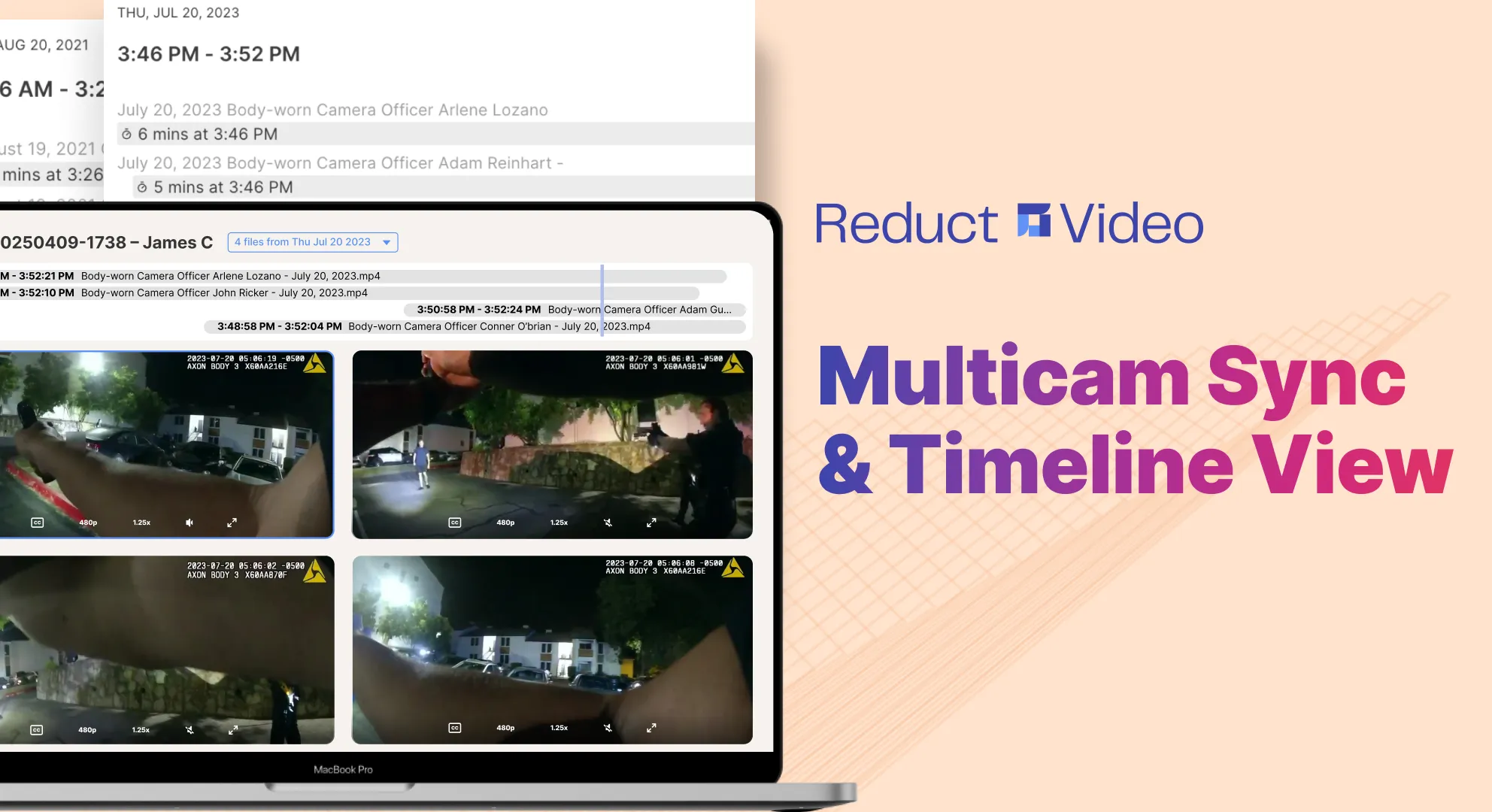
Timeline view organizes recordings chronologically so legal teams can immediately understand how evidence relates across an incident. Rather than manually stitching together disconnected files, defenders can see overlapping recordings on the multi-camera timeline as part of a single event.
This makes it easier to identify missing footage, detect gaps in recordings, understand officer sequencing, locate overlapping perspectives, and focus review around the incident itself instead of individual media files.
Chronology becomes visible immediately, and you don't have to manually reconstruct it through notes and timestamp comparisons.
With Reduct, you can also export the entire timeline view as a PDF for easy sharing or reference.
Understanding the full incident with multicam sync
Organizing footage chronologically helps establish sequence, but understanding the incident still requires seeing how those perspectives interact in real time.
When recordings are synchronized into a shared playback experience, defense teams can review multiple angles simultaneously rather than rewatching the same event repeatedly across separate files.
Multicam sync of the recordings gives defenders a clearer, more complete understanding of the incident by showing what each officer could see, what each microphone captured, how interactions evolved in real time, and where accounts begin to diverge.
This is especially valuable in use-of-force incidents, disputed commands, officer coordination, alleged resistance, and conflicting reports, where critical context can be missed when footage is reviewed separately.
A synced multicam review can reveal contradictions and context that are difficult to identify when footage is reviewed independently.
For example:
- One officer's bodycam may capture verbal instructions that another misses.
- One angle may show escalation occurring earlier than reports describe.
- A timeline gap may reveal that the footage is incomplete.
These details are often not obvious when reviewing files separately.
They emerge when the event is reconstructed by reviewing all the footage side by side.
Reduct automatically synchronizes footage using timestamps, metadata, and transcript overlap, allowing defenders to review incidents across multiple angles without manually aligning recordings.
It also lets you jump to the same moment across every synced angle directly from the transcript, turning what is traditionally a slow, file-by-file review process into a more contextual and searchable workflow.
Reducing review fatigue as a criminal defender
There's a practical reality behind reviewing an incident via hours of recordings: cognitive load.
Watching the same incident repeatedly across multiple files is mentally exhausting. Defenders must constantly track timestamps, remember sequencing, compare notes, and mentally synchronize overlapping events.
That process slows review and increases the likelihood that important details are overlooked.
An effective multicam sync reduces that burden by allowing defenders to streamline the incident, in context and across perspectives.
Instead of spending hours manually aligning recordings, legal teams can focus on:
- identifying inconsistencies,
- evaluating conduct,
- preparing cross-examination,
- and building the case strategy.
The goal is to gain a clear understanding of the incident and develop the narrative efficiently within the required timeframe.
The future of discovery review is contextual
As audiovisual discovery grows, the challenge is understanding what happened without missing any important pieces.
Defenders need tools built around chronology, synchronization, and contextual review, not just media playback. Because the whole story of the incident rarely exists in a single camera angle. It emerges across perspectives, timelines, and the gaps between them.
Reduct helps defense teams review audiovisual evidence as a connected sequence of events rather than isolated files, making complex discovery easier to understand and analyze.

TALK TO A PUBLIC DEFENDER
We're on your team

We believe the people building tools for defenders should understand what it actually takes to be one. So we have former public defenders helping us build the product. Have a question about whether Reduct fits your office? We’d love to talk to you.