What Is a Case Complexity System, and Why Does It Matter for Public Defenders?
October 2026
·
9 min read

When a county report lists your caseload at 100 open files, leadership assumes you're carrying 100 equal burdens. But every public defender knows the terrifying truth behind those numbers. Some files are routine misdemeanors, while others are bottomless pits.
Take these two, for example:
- The first is a straightforward misdemeanor with one police report.
- The second comes with 6 hours of bodycam footage, a client in custody who needs a Spanish interpreter, and a strong case for mental health diversion.
Your caseload report, however, counts both as a neat, uniform “1.” This mismatch makes it impossible to fairly allocate staff, justify budgets, or protect attorneys from burnout.
To fix that blind spot, the Los Angeles County Public Defender's Office (LACPD) built a tool called the Case Complexity System, or CCS. In August 2026, RAND published an independent evaluation of the system.
The researchers drew on attorney interviews, five years of case data, an eight-week time study, and an expert panel. The study covered only LACPD attorneys who represent adults in felony and misdemeanor cases, so everything below reflects one office’s experience.
I read through RAND’s report in detail to understand how CCS works in practice. Below, I’ll walk you through what CCS is, how it scores a case, and why it matters to anyone pushing for fair public defender workloads.
What is CCS?
CCS is LACPD’s own system for scoring adult felony and misdemeanor cases by the amount of attorney work each one is expected to need. Depending on where you practice, you may already know scores like these as case weights.
LACPD needed a system like this because of its size. It’s the largest public defense agency in the country, with more than 700 attorneys serving nearly 10 million residents. At that scale, just counting open cases doesn’t give you an accurate picture of who’s overloaded.
CCS was LACPD’s answer to that problem. It runs inside the office’s case management system and updates scores daily from live data. More than 200 attorneys helped shape it.
How does CCS work?
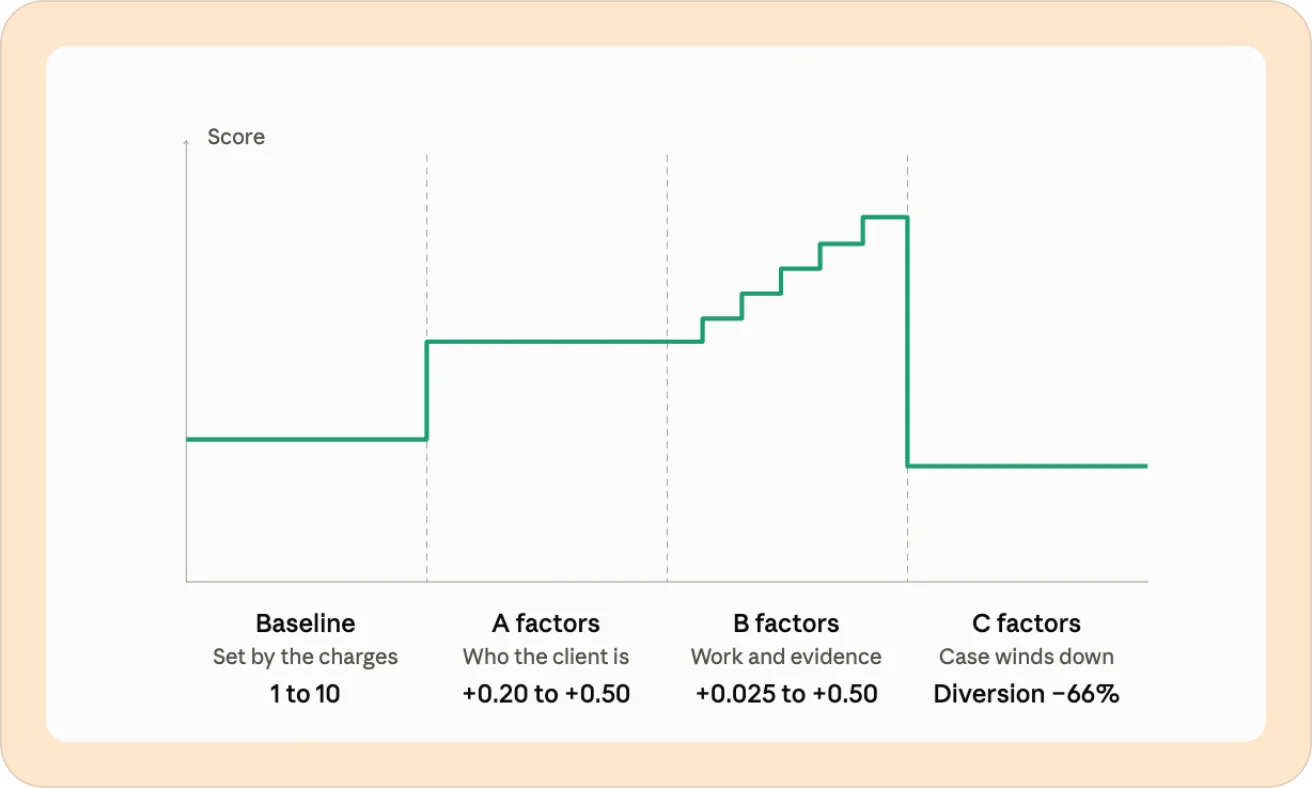
A CCS score follows a case through its life. It starts with the charges, grows as work piles up, and shrinks as things wind down. The system breaks this into four parts:
-
Baseline charge weight
When a case opens, CCS pulls the charges from the court’s system and assigns a starting score from 1 to 10. Felonies are scored on potential prison exposure, from 16 months up to death penalty cases. Misdemeanors are scored on offense type and maximum jail time, so a charge carrying 180 days starts at 2, while a DUI with injury starts at 6.
-
A factors (who the client is)
Circumstances known at intake add points. For example, a client who needs a Spanish interpreter adds 0.20, and other languages add 0.30. A mental illness adds 0.40 on a misdemeanor and 0.30 on a felony. Custody adds 0.50 on a misdemeanor, and a client who isn’t a U.S. citizen adds 0.50 on a misdemeanor or 0.25 on a felony.
-
B factors (how much work builds up)
The score climbs as you put in the work. Each in-person client visit adds 0.075, each written motion adds 0.25 to 0.50, and each expert you appoint adds 0.25. Digital evidence counts too. Every 900 MB of bodycam footage or jail call recordings adds 0.025. Most of these increases stop at a cap, often 2.00 points per factor.
-
C factors (when things slow down)
Scores drop as a case winds down. Pre-plea diversion cuts the score by 66%, and a negotiated plea heading to probation cuts it by 33%. An inactive misdemeanor loses 0.05 points a month after two months, rising to 0.15 a month after six.
Here’s how CCS would score the two cases
Say both are misdemeanors with a 180-day maximum, so each starts at a baseline of 2. At intake, before any discovery arrives, here’s how they compare:
| Factor | First case | Second case |
| Baseline (misdemeanor, 180-day max) | 2.00 | 2.00 |
| Client in custody | - | +0.50 |
| Spanish interpreter | - | +0.20 |
| Mental illness | - | +0.40 |
| Score before any work begins | 2.00 | 3.10 |
| On the caseload report | 1 case | 1 case |
That’s before any of the work factors come into play. Here’s what happens once you start working the case, with a few visits, a couple of motions, an expert, and the bodycam footage:
| Factor | First case | Second case |
| Baseline (misdemeanor, 180-day max) | 2.00 | 2.00 |
| Client in custody | - | +0.50 |
| Spanish interpreter | - | +0.20 |
| Mental illness | - | +0.40 |
| In-person client visits | +0.075 (1 visit) | +0.45 (6 visits) |
| 2 written motions | - | +0.50 |
| 1 expert appointed | - | +0.25 |
| 6 hours of bodycam (about 9 GB) | - | +0.25 |
| CCS score | 2.08 | 4.55 |
| On the caseload report | 1 case | 1 case |
By CCS’s math, the second case carries more than twice the weight of the first. But you might notice how little the work itself moved the score. Months of visits, motions, and footage review added less than 1.5 points, and 6 hours of bodycam added just 0.25.
That’s one of the gaps RAND flagged, and we’ll come back to it below.
Why CCS is at the center of the workload conversation
For decades, defender workloads have been measured by counting cases, but the work inside each one has gotten heavier. RAND points to three drivers in Los Angeles:
- new criminal justice reform laws
- expanded mental health diversion
- the growing volume of digital evidence
RAND asked a panel of experienced LACPD attorneys how many hours effective representation takes. Their estimates ranged from about 10 hours for a lower-level misdemeanor to 800 hours for the most serious felonies. A caseload of 100 can mean very different things depending on what’s in it.
That’s why offices across the country want defensible ways to weigh their work. The 2023 National Public Defense Workload Study set national benchmarks using a similar expert panel method. CCS tries to go further by scoring every file automatically and continuously. LACPD hopes to use those scores to justify budgets, match staff to demand, and show county leaders why more resources are needed.
What CCS gets right
CCS tracks relative complexity well in the aggregate. The cases attorneys spent the most time on, and the ones the expert panel rated most demanding, generally received higher scores.
Attorneys also told RAND that the factors CCS rewards, like client visits, expert appointments, and digital evidence, line up with the tasks they find most time-consuming.
Where CCS falls short
RAND was also clear that CCS isn’t ready to carry everything LACPD wants it to. Because the researchers studied only LACPD, these gaps describe how CCS performs inside one office:
- Scores don't translate into hours: A case scored 4 doesn't need twice the time of one scored 2, so CCS can rank cases but can't tell an office how many attorneys it needs.
- It only counts what's entered correctly: Free-text notes are ignored, many attorneys skip entering full sentencing exposure, and a system defect left many 2024 cases without baseline scores.
- Caps flatten the hardest cases: Once a score hits its ceiling, months of extra litigation stop counting.
- Dormant files stay heavy: Scores drop slowly for inactive cases, which inflates an attorney's apparent load.
- One score is doing three jobs: RAND recommends separate versions for budgets, office planning, and individual workload checks.
- Some work is underweighted: In the example above, 6 hours of bodycam added just 0.25. Attorneys said footage and mental health diversion can turn a routine case into a demanding one, and CCS doesn't keep up.
What this means for every defender office
CCS is built for Los Angeles, but its lesson applies anywhere. A system can only count the work it can see.
RAND's report also says offices need staff whose job is handling bodycam footage and other digital evidence. That includes watching videos and making transcripts, especially for recordings that aren't in English. Those tasks eat up hours of an attorney's week, and almost none of them show up in a case count.
Tools like Reduct.Video can help cut down review time by turning hours of footage into searchable, timestamped transcripts your team can label, comment on, and clip together.
But first, footage review has to count as real work.
TALK TO A PUBLIC DEFENDER
We're on your team
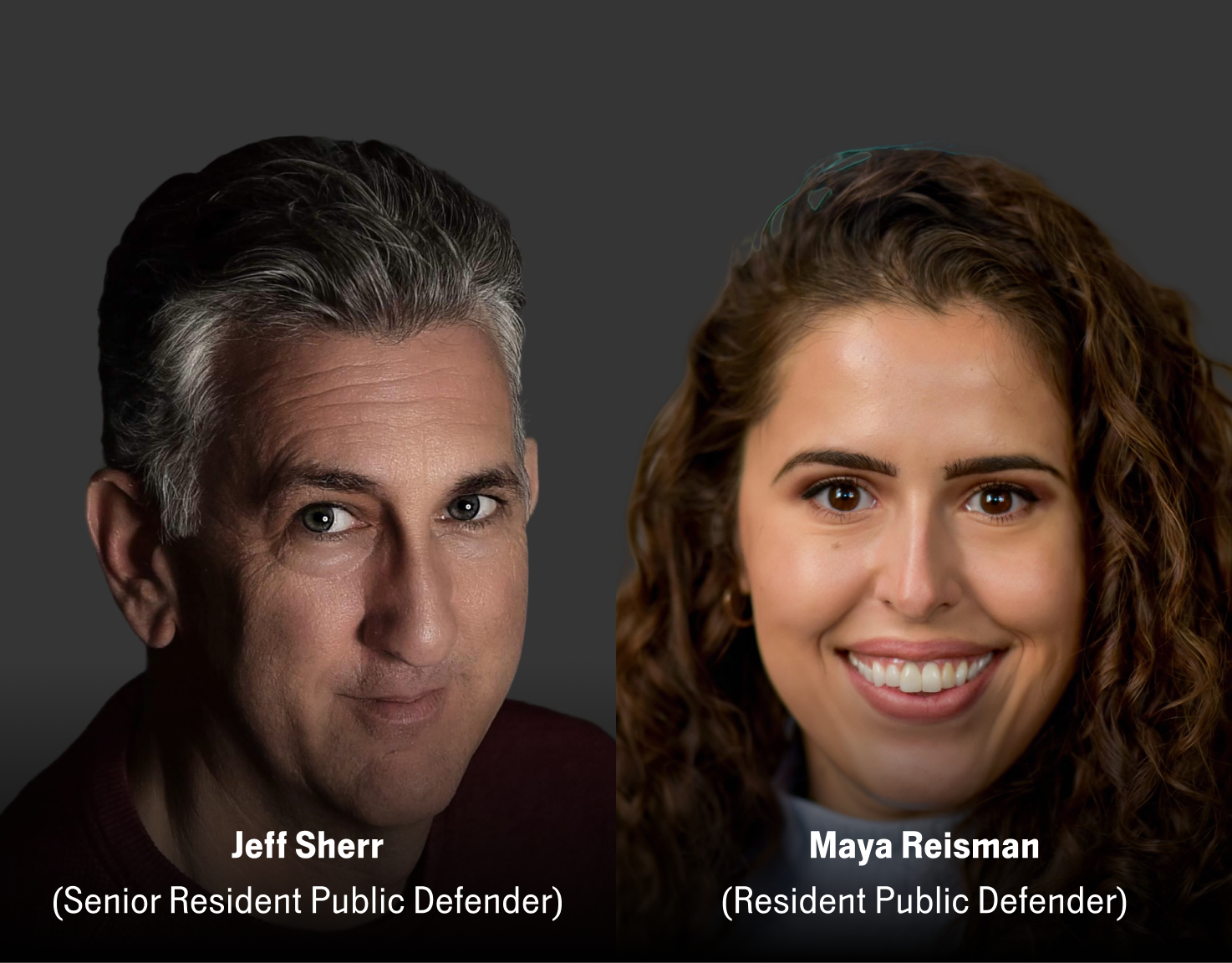
We believe the people building tools for defenders should understand what it actually takes to be one. So we have former public defenders helping us build the product. Have a question about whether Reduct fits your office? We’d love to talk to you.